Greek tours start in Athens, reach the monasteries of Meteora and sail out to Santorini, Crete, Corfu and Rhodes. This page lines up each trip in one place, so you can compare what it visits before you book.
Start at the top or jump to your island. Each tour card here opens a live booking on GetYourGuide. The last section answers the questions travelers ask about Greek tours. You can read about the people behind this site on our about page.
Which Greek tours start in Athens?
Greek tours that start in Athens visit the Acropolis and its museum, the Ancient Agora, Plaka, and the Panathenaic Stadium. Athens also has hop-on hop-off sightseeing buses. The Greek Ministry of Culture sets the hours and entry rules for the Acropolis.
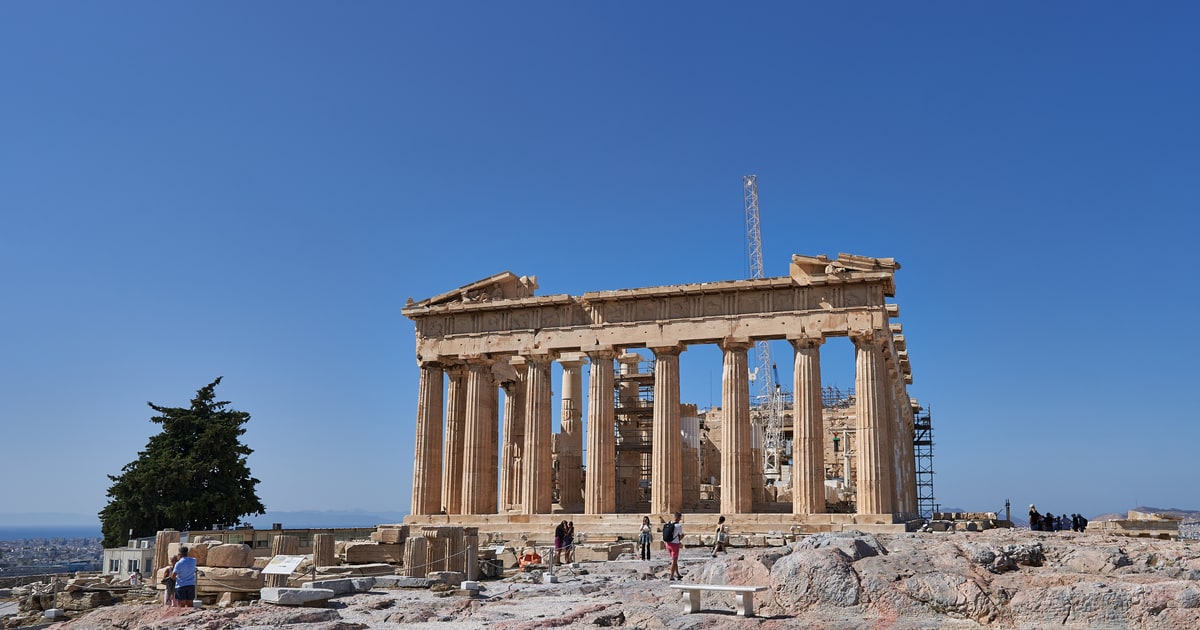
Greek tours in Athens visit the Acropolis, a rocky crag in the center of the modern city. The Ministry of Culture calls it the greatest sanctuary of ancient Athens. Pericles started a building project there in the mid-fifth century BC. The Temple of Athena Nike, the Erechtheion, the Propylaia and the Parthenon came from that project.
Greek tours enter the Acropolis from the west, the only side with access. You go in through the Beule Gate or a small door under the Temple of Athena Nike. Then you reach the Propylaia, the monumental entrance built by the architect Mnesikles. The Temple of Athena Nike stands on the bastion south of it.
Greek tours of the Acropolis include the Parthenon, the largest temple on the rock. It is dedicated to Athena Parthenos and replaced two earlier temples of the same goddess. The architects Ictinos and Callicrates worked on it. On the north side stands the Erechtheion, an Ionic temple of Athena and Poseidon-Erechtheus. It has a porch of the Karyatides.
Plan Greek tours around the Ministry’s hours for the Acropolis. In summer the site is open from 8:00 to 20:00, with last entrance at 19:30. In winter it is open from 8:00 to 17:00, with last entrance at 16:30. Closing time moves earlier in steps through September and October, reaching 18:00 in late October.
Tickets are sold at the ticket offices on site and online through the Ministry’s official e-ticketing service. Every visit, including Greek tours, follows one ticket rule. The Acropolis and Slopes ticket is used only once. If you exit, you cannot re-enter any site with it. Small backpacks and handbags can go in, but the cloakroom takes no large luggage.
- Metro station Acropolis leads to the site along Dionysiou Areopagitou Street.
- Metro station Monastiraki leads there through the Ancient Agora or Plaka.
- Food, drinks, and smoking are prohibited on the site.
- Do not touch any work of art, and follow the marked routes.
- The Ministry recommends footwear suitable for walking.
- The site closes on national holidays such as 25 March and Easter Sunday.
Greek tours in Athens include the Acropolis Museum, which holds finds from only one site. It stands in Makryianni, about 300 meters southeast of the Parthenon. The Parthenon Gallery on the top floor shows the temple’s sculptures. Glass floors show the ancient neighborhood excavated beneath the building. On Fridays the museum stays open until 10 pm.
Greek tours also walk through the Ancient Agora, which the Ministry calls the heart of ancient Athens. It lies northwest of the Acropolis, and the Panathenaic Way ran through it. The Temple of Hephaistos overlooks the square from the hill to the west. The Stoa of Attalos was fully restored and now serves as the site museum.
Greek tours also cover Plaka, the old neighborhood on the northeast slope of the Acropolis. It is known as the Neighborhood of the Gods, and Adrianou Street is its largest street. The Panathenaic Stadium is the only stadium in the world built entirely of marble. It held the opening and closing ceremonies of the first modern Olympics.
Greek tours in Athens include city sightseeing by bus. On a hop-on hop-off bus you leave at a stop you like and board a later bus. One Athens line gives commentary in 13 languages and starts at Syntagma Square. The commentary runs from ancient times up to modern times, heard from the top deck.
Which Greek tours leave Athens for Delphi, Mycenae and Olympia?
Greek tours leave Athens for Delphi, Mycenae with Epidaurus and Nafplio, Cape Sounion, and Ancient Olympia. Daily services from Athens take about 2.5 hours to Delphi and 4 to 4.5 hours to Olympia. They take 1.5 to 2 hours to Nafplio and 2 to 2.5 hours to Epidaurus.
Greek tours to Delphi reach an ancient sacred precinct in central Greece. Apollo’s sacred precinct there was a Panhellenic Sanctuary. The site lies on the southwestern slope of Mount Parnassus and is on the UNESCO World Heritage list. The Temple of Apollo, in ruins today, dates from the fourth century BC.
At Delphi, the theater stands farther up the hill from the temple, and the stadium is higher still. The Delphi Archaeological Museum has fourteen rooms on two levels. Greek tours that include it show statues such as the Charioteer of Delphi. One room displays the Sphinx of Naxos.
Greek tours that pair Delphi with Arachova head to a mountain town on the southern slope of Mount Parnassus. Arachova lies 8 kilometers east of Delphi. It sits at an elevation of about 970 meters (3,182 feet). Its Formaela cheese holds protected designation of origin status.
Greek tours to Mycenae go to a site about 120 kilometers (75 miles) southwest of Athens. The citadel stands on a hill 274 meters (899 feet) above sea level. Its main entrance is the Lion Gate, built around 1,250 BC. Two lions or lionesses in a heraldic pose stand above it.
The Treasury of Atreus sits near the site that Greek tours of Mycenae visit. It is a large tholos, or beehive tomb, about 500 meters south-southwest of the Lion Gate. Its dome is 14.5 meters wide and 13.2 meters high. For over a thousand years it was the tallest and widest stone dome in the world.
Greek tours to Epidaurus reach the Argolid Peninsula on the Saronic Gulf. Epidaurus is known for its healing sanctuary of Asklepios. Polykleitos the Younger designed its ancient theater in the 4th century BC. The theater seats up to 14,000 people. The theater has a long reputation for exceptional acoustics, yet measurements on site somewhat moderate that claim.
Greek tours to Nafplio reach a town on the Argolic Gulf in the northeast Peloponnese. Nafplio was the first capital of the modern Greek state. A castle named Palamidi stands at its highest point. Bourtzi is a fortress on an islet in the middle of the harbor.
Greek tours to Cape Sounion reach the southernmost tip of the Attica peninsula. It lies 69.5 kilometers southeast of Athens. The Temple of Poseidon was built from 444 to 440 BC. It had 34 Doric columns of local white marble, and 15 still stand. Cape Sounion remains a popular day trip from Athens, with sunset over the Aegean Sea.
Greek tours to Ancient Olympia reach a small town in Elis on the Peloponnese peninsula. The Games were held there every four years, in honor of Zeus. By tradition, the first Games date to 776 BC. At first the only event was the stadion, a race of about 190 meters.
- Stadium: the field has start and end lines marked by curbing. Its length became the stadion, an ancient Greek unit of distance. Spectators sat on the sloping flanks.
- Temple of Zeus: built between about 472 and 456 BC. It housed the gold and ivory statue of Zeus, about 13 meters (43 feet) high. The statue is listed among the Seven Wonders of the Ancient World.
- Temple of Hera: built around 600 to 580 BC. It is the oldest temple at Olympia.
- Olympic flame: it is lit by reflecting sunlight in a parabolic mirror in front of the Temple of Hera.
Which Greek tours visit the Meteora monasteries?
Greek tours to the Meteora monasteries include day trips and a full-day bus trip from Thessaloniki. Meteora is a group of rock pillars in Thessaly, and six of its monasteries are open to visitors. Northern Greece also holds Dion, Mount Olympus, Edessa and the Pozar baths.
Greek tours to Meteora take you to unusual columns of rock that rise steeply from the ground. Water, wind and extreme temperatures shaped the huge pillars by weathering along vertical faults. The name Meteora means lofty and elevated. It is related to the word meteor.
Pick Greek tours to Meteora for a look at the six monasteries that remain. The count peaked at 24 in the 16th century. UNESCO added the complex of the six surviving monasteries to its World Heritage List. Four are active: Great Meteoron, Varlaam, Holy Trinity and Saint Stephen.
On Greek tours, you see Meteora between the town of Kalabaka and the village of Kastraki. Kalabaka, spelled Kalambaka too, sits at the base of the Meteora massif. Kastraki belongs to the community of Kalabaka and lies on the west side of the massif. Choose Kastraki to stay closer to the rocks. Choose Kalambaka for better amenities and easier transit.
Every visitor on Greek tours to Meteora follows the dress code. Men wear pants that cover the knees. Women wear skirts or sarongs, not pants, and keep their shoulders covered. Skirts can be borrowed at the entrance stations. Photography and video are not allowed inside the inner church sanctuaries.
Check closing days before you book Greek tours to Meteora. From April to October, each monastery shuts for one day a week. The shut days are staggered. In summer, Great Meteoron is closed on Tuesdays, Varlaam on Fridays and Saint Stephen on Mondays. Except for Saint Stephen, each monastery needs a climb up hundreds of steep steps.
- From Athens, the drive to Meteora takes about 4 hours.
- Buses leave Athens about every two hours, and the ride takes about 5 hours.
- For Greek tours that start in Thessaloniki, Kalambaka lies about 240 kilometers southwest, and the highway drive takes about three hours.
Thessaloniki is the starting point for Greek tours in northern Greece. It is the second-largest city in Greece and the capital of Central Macedonia. The city sits on the Thermaic Gulf, at the northwest corner of the Aegean Sea. King Cassander of Macedon founded it around 315 BC. Its port makes it a transport hub.
Greek tours from Thessaloniki include a day trip to Dion and Mount Olympus Park. Dion is known for its ancient Macedonian sanctuary of Zeus. It was the sacred place of the ancient Macedonians. The village sits at the foot of Mount Olympus, 17 kilometers from Katerini. Much of the ancient city is visible in the Archaeological Park of Dion.
Greek tours to Mount Olympus Park reach the home of the Twelve Olympian gods in myth. Mytikas, its highest peak, rises to 2,918 meters and is the highest peak in Greece. Olympus is the first national park in Greece. The mountain lies about 80 kilometers southwest of Thessaloniki. The usual starting point for climbers is the town of Litochoro.
Look for Greek tours that stop at Edessa, a city in Northern Greece. Twelve waterfalls lie in the area, and four are easily visible. The waterfalls are the main attraction of visitors to Edessa. The Pozar thermal baths lie 13 kilometers northwest of Aridea. Their water holds a constant temperature of 37 degrees Celsius.
Which Greek tours sail around Santorini and the Cyclades?
Greek tours around Santorini sail the caldera, a seawater-filled volcanic basin that measures about 12 by 7 kilometers. Tour boats depart from Skala for Nea Kameni and other Santorini destinations. Island tours also reach Delos from Mykonos and the Kleftiko sea caves on Milos.
Greek tours of Santorini start with the volcano that shaped the island. The current caldera formed about 3,600 years ago during the Minoan eruption. Steep cliffs, 300 meters high, rise on three sides. Nea Kameni and Palea Kameni, two small volcanic islands, sit near the center. Thirasia and Aspronisi lie at the edge.
Greek tours that visit the volcano stop at Nea Kameni, a small island with no residents. It formed from volcanic activity and is almost round, about 2 kilometers across. Dozens of tourist boats visit it daily throughout the summer. The island has an active sulfur vent named Jorgo. Scientists monitor it closely.
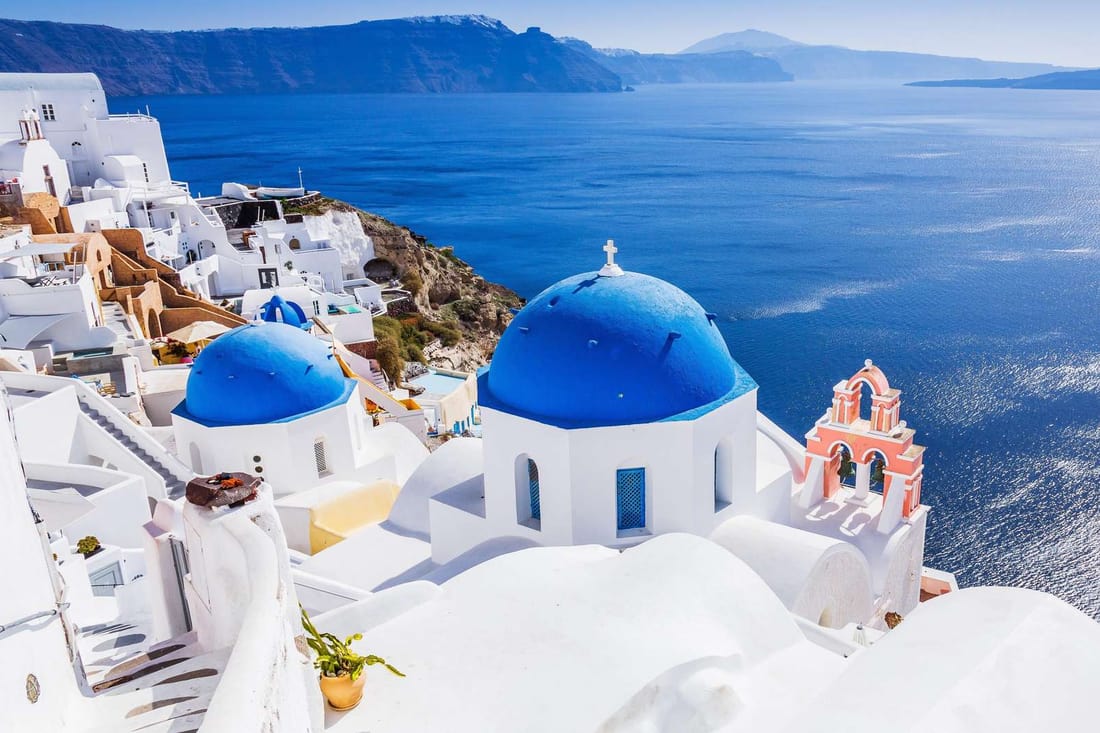
On Greek tours of the caldera, the smaller island next to Nea Kameni is Palea Kameni, which means Old Kameni. The island contains a hot spring. Tourists can swim to it from nearby Nea Kameni. Thirasia is the second largest island of the group. It lies north-west of Nea Kameni.
Greek tours that end in Oia chase the sunset. Oia lies on the northwest edge of Santorini. From there you see the sunset over the caldera. At dusk, crowds gather in the town to watch. Fira is the modern capital of the island and stands on the edge of the caldera.
Greek tours that look at the past of Santorini point to Akrotiri, a Cycladic Bronze Age settlement site. The Theran eruption destroyed the settlement. Volcanic ash buried it, which helped preserve its fine frescoes. Diggers also found pottery, furniture, advanced drainage systems and three-story buildings at the site.
Greek tours in the Cyclades reach Mykonos, an island of 85.5 square kilometers between Tinos, Syros, Paros and Naxos. The main town is also known as Chora. Windmills are a defining feature of the landscape. Flights from Athens take 45 minutes, and high-speed vessels visit daily from Athens.
Greek tours from Mykonos add a stop at Delos, a small island near the center of the Cyclades. It covers only 3.43 square kilometers. In myth, Apollo and Artemis were born on Delos. The island is on the UNESCO World Heritage list. A boat from Mykonos needs about 30 minutes. Overnight stays on Delos are forbidden.
Greek tours of Milos head for Kleftiko by boat. Milos is the farthest island to the southwest in the Cyclades, and it is of volcanic origin. Kleftiko is known for white sea caves and towering rock arches, once used by pirates as a hideout. It is accessible mainly by boat. Flights from Athens to Milos take 40 minutes.
Greek tours of the Cyclades begin with a short flight or a ferry ride. Flights from Athens to Santorini take 50 minutes. Santorini is connected by ferry with Piraeus daily, all year long. Fast ferries take about 4 to 5 hours, and standard ferries take 7 to 9 hours. One boat tour around the caldera lasts 6 hours.
Which Greek tours cover Crete?
Greek tours of Crete cover the Minoan palace of Knossos, Spinalonga island, the Balos lagoon and the CRETAquarium. Crete is the largest island in Greece and covers 260 km from west to east. The west holds the Samaria Gorge and the pink sand of Elafonisi.
Greek tours of Crete take place on the fifth largest island in the Mediterranean. It is 60 km wide at its widest point and narrows to as little as 12 km near Ierapetra. Its coastline is 1,046 km (650 miles) long. A mountain range crosses the island and includes Mount Ida, its highest point.
Four towns give Greek tours of Crete their starting points: Heraklion, Chania, Rethymno and Agios Nikolaos. Heraklion is the capital and largest city, on the island’s north shore. Chania lies 145 km (90 miles) west of Heraklion and about 70 km west of Rethymno. The Republic of Venice built almost all of the old town of Rethymno.
Greek tours that stop at Knossos visit a palace of the Minoans, widely regarded as Europe’s earliest advanced civilization. The multi-storey complex covered about 20,000 square meters. Arthur Evans began large-scale excavations there. Greek myth says King Minos ordered Daedalus to build the Labyrinth for the Minotaur.
Greek tours of Heraklion add the Archaeological Museum in the town center. It is one of the largest museums in Greece. It holds the great majority of the finds from the Minoan palace at Knossos and other Minoan sites in Crete. The Phaistos Disc, the snake goddess figurines and the bull-leaping fresco from Knossos are on show there.
Greek tours of eastern Crete reach Spinalonga, a rocky island at the northern mouth of the Gulf of Elounda. The island was a fortress for centuries under Venetian rule. In the early 20th century it became a leper colony. It covers only 85,000 square meters. Only the Palace of Knossos gets more visitors in Crete.
Greek tours to Balos head for the northwestern tip of Crete, in the Chania regional unit. Balos is a lagoon between the island of Gramvousa and the coast of Crete. Gramvousa is a pair of small uninhabited islands. Imeri Gramvousa holds the remains of a Venetian fort. The municipality of Kissamos administers both islands.
Greek tours of western Crete include Elafonisi, an island close to the southwestern corner of Crete. Its name means Deer Island. It is known for its pink sand beaches. When the weather is fine, visitors wade across shallow water to reach the island. The island is a protected nature reserve.
Greek tours of the White Mountains lead into the Samaria Gorge, a national park 16 km long. The walk takes five to seven hours. At the Gates, the walls close in to a width of only four meters. Imbros Gorge runs parallel to it, and its narrowest part is 1.60 meters wide.
Greek tours around Heraklion include the CRETAquarium, a public aquarium near the town of Gournes. A public marine research institution runs it. Its exhibits are split into five sections. In the Open Sea section you can see sand tiger sharks and loggerhead sea turtles. Another section shows tropical fish such as clownfish.
- Knossos: about 5 km (3.1 miles) south of the historic center of Heraklion. It is part of the UNESCO World Heritage Site called Minoan Palatial Centres.
- CRETAquarium: 15 km east of Heraklion.
- Spinalonga: tourist boats leave from Plaka, Elounda and Agios Nikolaos.
- Elounda: a small town on the north coast, 12 km by road from Agios Nikolaos. It is the closest major town to Spinalonga.
- Balos and Gramvousa: reached by boat from Kissamos, or by a dirt road and a hike.
- Elafonisi: about 80 km southwest of Chania.
- Samaria Gorge: you walk from the Omalos plateau to Agia Roumeli on the Libyan Sea. From there you sail to Sougia or Chora Sfakion and catch a coach back to Chania.
- Imbros Gorge: near Chora Sfakion, ending at the village of Kommitades. Before the road was built, its mule trail was the only link between Chania and Chora Sfakion.
Which Greek tours visit Corfu and Rhodes?
Greek tours reach Corfu in the Ionian Islands and Rhodes in the Dodecanese. Corfu stops include the UNESCO Old Town, Paleokastritsa and boat trips to Paxos. Rhodes stops include the medieval city, Lindos, Seven Springs and Symi.
Greek tours in the Ionian Islands include Corfu, in the northwestern corner of Greece. The Ionian Islands lie in the Ionian Sea, west of mainland Greece. The Old Town of Corfu is a UNESCO World Heritage Site. It hosts palaces, stone-paved alleys, squares and imposing churches.
Greek tours of Corfu Town include the Old Venetian Fortress. The fortress covers the promontory that first held the old town. The Venetians built a sea channel called the Contrafossa. It separated the fortress from the rest of the city and made the citadel an artificial island. An esplanade called the Liston lies between the town and the citadel.
On greek tours of the west coast, Paleokastritsa sits just south of Angelokastro. It is known for great cliffs and nearby beaches. Its monastery houses a museum. The Achilleion stands in Gastouri, a village about ten kilometers south of Corfu city. The palace was built for Empress Elisabeth of Austria. Today it is a museum.
Greek tours by boat go from Corfu to Paxos. Paxos is about 15 kilometers off the southern tip of Corfu, and Antipaxos is 5 kilometers further southeast. Steep chalky cliffs on the west coast of Paxos hold blue caves. In the tourist season, hydrofoils, passenger ferries and sea-taxis run from Corfu in one to two hours.
Greek tours in the Dodecanese include Rhodes, the largest of Greece’s Dodecanese islands. The Dodecanese lie in the southeastern Aegean Sea. The city of Rhodes sits at the northern tip of the island. The Colossus of Rhodes, one of the Seven Wonders of the Ancient World, was erected at the harbor of Rhodes. No trace of the statue remains today.
Greek tours of Rhodes Town enter the medieval city of Rhodes, a UNESCO World Heritage Site. A wall 4 kilometers long surrounds it. The Palace of the Grand Master is a medieval castle in the city. It was built in the late seventh century as a Byzantine citadel. The Knights Hospitaller later made it their administrative center.
Greek tours of the east coast of Rhodes stop at Lindos. Above the modern town rises the acropolis of Lindos, a natural citadel. The Doric Temple of Athena Lindia, from about 300 BC, stands on the site of an earlier temple. The bus from Rhodes city takes 1 hour 15 minutes. Boats also reach Lindos from Mandraki harbor.
Greek tours on Rhodes reach Seven Springs, close to the town of Archangelos. A tunnel 150 meters long and 2.5 meters high channels the springs’ water into a small lake. A bus from the Central Bus Station of Rhodes goes to Kolymbia or Archangelos. The walk from there to the entrance takes about 1 hour.
Greek tours by sea link Rhodes with Symi, a Dodecanese island about 24 kilometers north of Rhodes. Ferries and fast catamarans run between the two islands every day. The port of Gialos is a popular marina for sailors. Saint George’s Bay can be reached only by boat. The Panormitis monastery is dedicated to Saint Michael.
How do you plan Greek tours?
Plan Greek tours in this order: pick the season, check the meltemi wind, then match the ferry timetable. Greece has a Mediterranean climate, so the weather, the wind and the sailings change from season to season.
Greek tours run in a Mediterranean climate, which visitgreece.gr describes as sunny, with mild temperatures and limited rainfall. Summer days are dry and hot. Winters are mild in lowland areas, with a minimum amount of snow and ice. The same season can bring mild heat near the sea and cool air in the mountains.
Greek tours in spring meet warm weather, bright blue skies and plenty of sunshine, according to visitgreece.gr. The same site says September and October are renowned for their pleasant temperatures. It adds that the Greek seas stay warm until November, a stretch Greeks call mini summer.
Check the meltemi before you book Greek tours that cross the sea. This north wind of the Aegean blows with its highest frequency in July and August. Its force can climb to 7 or 8 on the Beaufort scale, and it is strongest in the afternoon. It comes up in clear weather without warning.
Plan Greek tours with island stops around two Athens gateways. Athens International Airport offers frequent domestic flights to mainland cities and islands. Piraeus, the port of Athens, is the largest port in Greece. Internal flights effectively connect every part of the country, says visitgreece.gr.
Ferries from Piraeus sail to the Cyclades, Crete, the North Aegean islands and the Dodecanese. You can pick a conventional ferry or a high-speed catamaran. Routes and the ferries that serve them are subject to change. Check the timetable for your date before you book Greek tours with a sea crossing.
A day trip starts at your hotel in the morning. It returns you to the same lodging in the evening, so it needs no overnight stay. Before you set a date for Greek tours, check the closed days. Ministry museums close on 1 January, 25 March, Greek Orthodox Easter Sunday and 25 and 26 December, among other holidays.
What do travelers ask before booking Greek tours?
When is the right time of year for Greek tours?
Travel before the peak season, since visitgreece.gr lists smaller crowds at beaches, museums and archaeological sites as a benefit. In quiet areas, fewer visitors can also mean fewer transport links and fewer amenities open.
How much time do you need for Greek tours that combine Athens and the islands?
Let the ferry timetable set the length. A ferry page for Iraklia says departures are not daily all year, so build your trip around the boat.
Do ferries run every day to the islands?
Not on every route in every season: sailings thin out in winter, with more choice from spring to autumn. The port authority can hold departures when conditions are unsafe.
How do you book Greek tours online?
The booking cards on this page open GetYourGuide. There you pick the date and the group size. If you have a question first, write to us on the contact page.
Are Greek tours possible in winter?
Yes, visitgreece.gr invites you to skip the summer crowds and visit in winter. It calls the Athenian winter mild. From November to March, Ministry museums open from 08:30 to 15:30, or from 09:00 to 16:00 for the major ones.